The Quest for Precision in Cybersecurity: Why GenAI Must Adapt to Win
.jpeg)


In cybersecurity, precision is not a luxury. It is a necessity.
We see this every day. Whether a security team is triaging new software vulnerabilities, correlating threat intelligence, or responding to active incidents, the cost of imprecision is real. False positives drain analyst time and erode trust in tooling. False negatives leave systems exposed to exploitation and data loss. As environments scale and threats evolve, the sheer volume and complexity of security data make manual analysis infeasible. Automation has to fill the gap.
But in cybersecurity, automation only works if it is reliable, consistent, and precise.
Why GenAI Struggles with Precision in Cybersecurity
Generative AI has enormous promise in this domain. Modern large language models and retrieval-augmented systems can read, reason, and summarize at machine scale. They can help analysts process vulnerability descriptions, threat reports, and incident data far faster than any human team.
The challenge is that delivering consistent precision with GenAI remains one of the hardest problems in cybersecurity.
Unlike traditional rule-based systems, which behave predictably within fixed boundaries, GenAI models operate on patterns learned from vast corpora. That flexibility is powerful, but it comes with tradeoffs. They can generate insightful summaries, surface latent patterns, and assist in complex reasoning, but they can also produce plausible-looking misinformation or “hallucinations” when contexts are subtle or data drifts.
For cybersecurity tasks like vulnerability triage, this is a serious issue. Interpreting a CVE description, assessing real-world exploitability, and translating those findings into actionable severity decisions are critical steps. Ambiguity or hallucination in these workflows directly undermines trust.
This is why “just applying GenAI” is not enough.
Precision Requires Adaptation, Not Just Intelligence
In a new paper The Road of Adaptive AI for Precision in Cybersecurity, I frame cybersecurity as a domain defined by constant change. Knowledge bases evolve. Tooling changes. Threat actors adapt. Even the language we use to describe attacks shifts as new techniques emerge. If the domain itself is adaptive, the AI systems operating within it must be adaptive as well.
High-precision GenAI systems cannot rely on static models frozen in time. They require mechanisms that allow them to adjust to new information and new contexts as they arise. Without this capability, precision inevitably degrades as the environment changes.
In the paper, I outline two core forms of adaptation that are critical to making GenAI trustworthy in real-world security operations.
Retrieval-Level Adaptation: Contextual Grounding at Inference Time
Retrieval-level adaptation ensures that the GenAI system grounds its outputs in relevant, up-to-date information by integrating domain knowledge bases and external context at query time. This approach anchors generative reasoning in factual sources and reduces the risk of incorrect generalizations.
In practice, this means model outputs are conditioned on the current state of vulnerabilities, configurations, and environmental context rather than relying solely on patterns learned during pretraining. For cybersecurity workflows such as vulnerability triage or exposure analysis, this grounding is essential to maintaining precision as the domain evolves.
Model-Level Adaptation: Continual Alignment with the Domain
Model-level adaptation involves tuning and refining model behavior based on operational feedback, such as adjusting model parameters or fine-tuning on curated cybersecurity datasets to reflect domain-specific semantics. This continual learning helps the system remain aligned with evolving threat vocabularies and analytical priorities.
As new attack techniques emerge and defensive practices change, models that lack this adaptive capability risk drifting toward generic or outdated interpretations. Model-level adaptation provides a mechanism for sustaining precision over time, even as the underlying threat landscape shifts.
Engineering Precision as a System Property in Cybersecurity
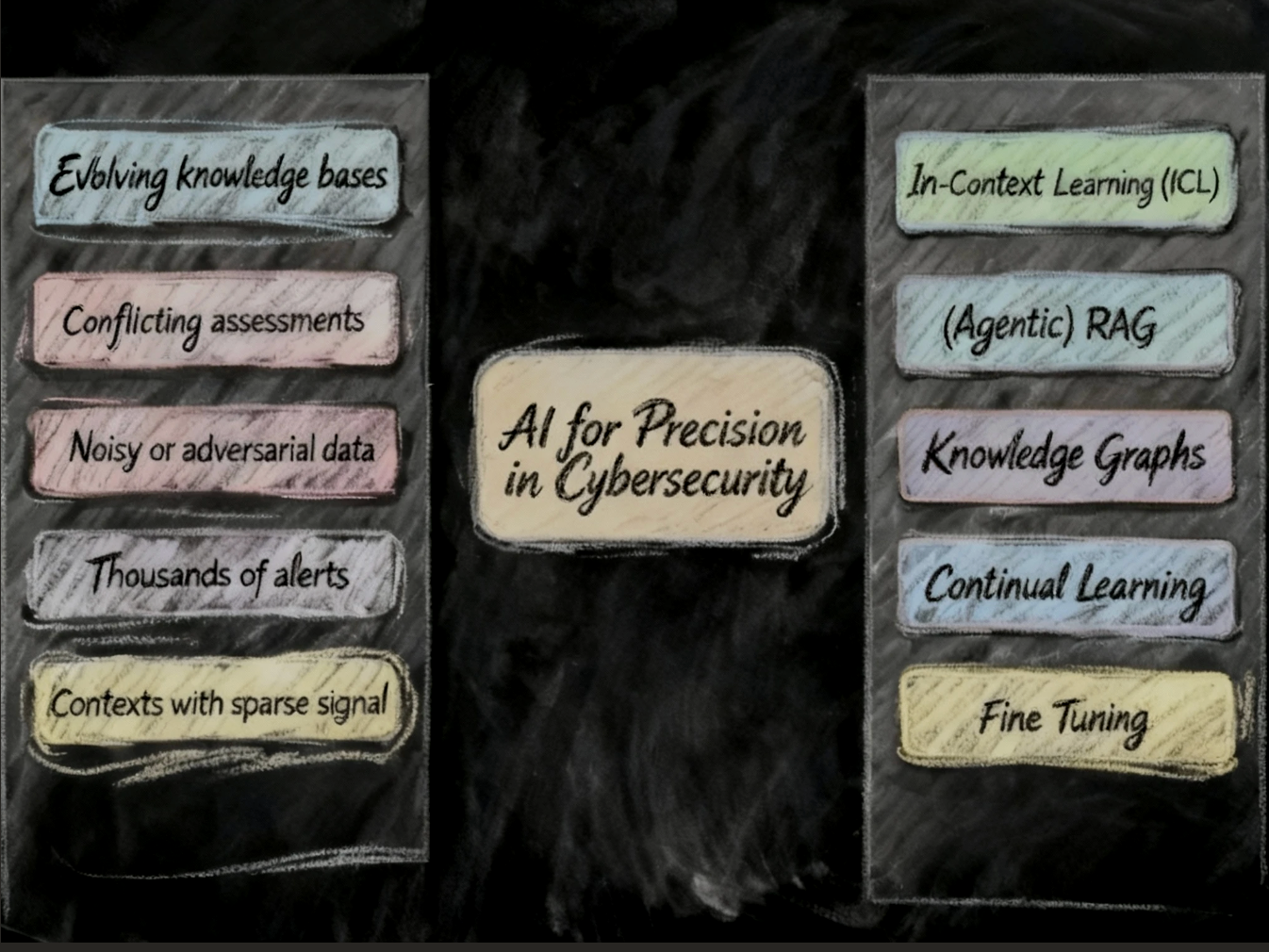
By combining retrieval-level and model-level adaptation into an end-to-end pipeline, it becomes possible to move closer to consistent precision. Such systems do not merely generate relevant insights once, but do so repeatedly as conditions change, which is essential in real-world cybersecurity environments. The figure above illustrates how the challenges security teams face, including evolving knowledge bases, noisy data, and sparse signal, must be met with adaptive mechanisms such as retrieval-augmented generation and continual learning to achieve consistent precision.
Imprecision in cybersecurity is unforgiving. False alarms consume limited analyst attention, while missed detections leave exploitable paths unaddressed. While GenAI has the potential to accelerate analytical tasks such as vulnerability triage, achieving consistent precision requires adaptive architectures that ground generative reasoning in current, relevant knowledge and evolve alongside the domain. As argued throughout this paper, precision must be treated as an architectural property, deliberately engineered rather than assumed.
Featured Blog Posts
Explore our latest blog posts on cybersecurity vulnerabilities.


Ready to Reduce Cloud Security Noise and Act Faster?
Discover the power of Averlon’s AI-driven insights. Identify and prioritize real threats faster and drive a swift, targeted response to regain control of your cloud. Shrink the time to resolution for critical risk by up to 90%.