Averlon + Wiz: Accelerate Remediation and Reduce Exposure


Security teams today face an expanding challenge. Cloud, hybrid, and application environments continue to grow faster than most teams can secure them.
Advances in AI-powered development have only exacerbated what was an already tenuous condition for the security teams trying to minimize risk exposure and accelerate the mean time to remediation (MTTR).
Together, Averlon and Wiz power a continuous threat exposure management (CTEM) cycle that connects Wiz’s deep risk visibility and context with Averlon’s agentic prioritization and remediation, enabling teams to eliminate exposure faster through smarter triage and safer remediation.
Wiz gives organizations deep visibility and risk context across cloud and hybrid environments, spanning configurations, identities, and workloads.
Averlon builds on that risk context with agentic decisioning, automatically triaging exploitable vulnerabilities and accelerating remediation across developer workflows.
From Risk Context to Environment-Aware Triage
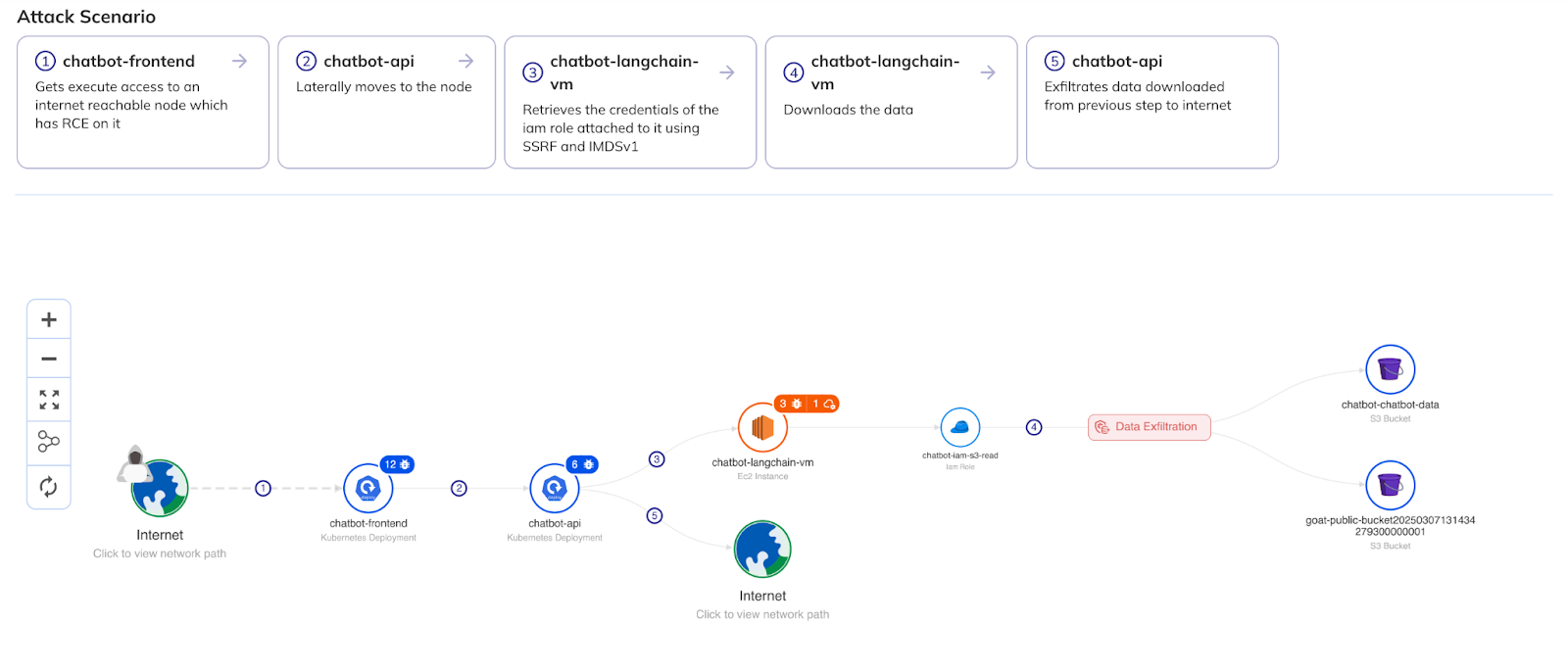
Wiz delivers rich insights and risk context across configurations, identities, and vulnerabilities. Building on Wiz’s risk context, Averlon AI agents evaluate the exploitability of identified exposures in the deployed environment to determine what should be addressed first and drive remediation through developer workflows.
Averlon’s AI agents analyze data from Wiz alongside other sources, evaluating the customer’s deployed environment to assess exploitability signals such as applicability and reachability. Applicability determines whether the risk is present and relevant in a customer environment, for example, a Bluetooth driver vulnerability is rarely applicable in a cloud workload. Reachability examines whether that component can be accessed through a real attack pathway in the running environment, for example, is a vulnerable container actively deployed.
Averlon builds on Wiz’s risk context by correlating it with other security signals to construct an environment-aware attack chain, helping teams prioritize what to fix first and remediate it safely. This turns risk visibility into execution-ready remediation actions, grounded in real-world impact.
Remediation That Meets Developers Where They Work
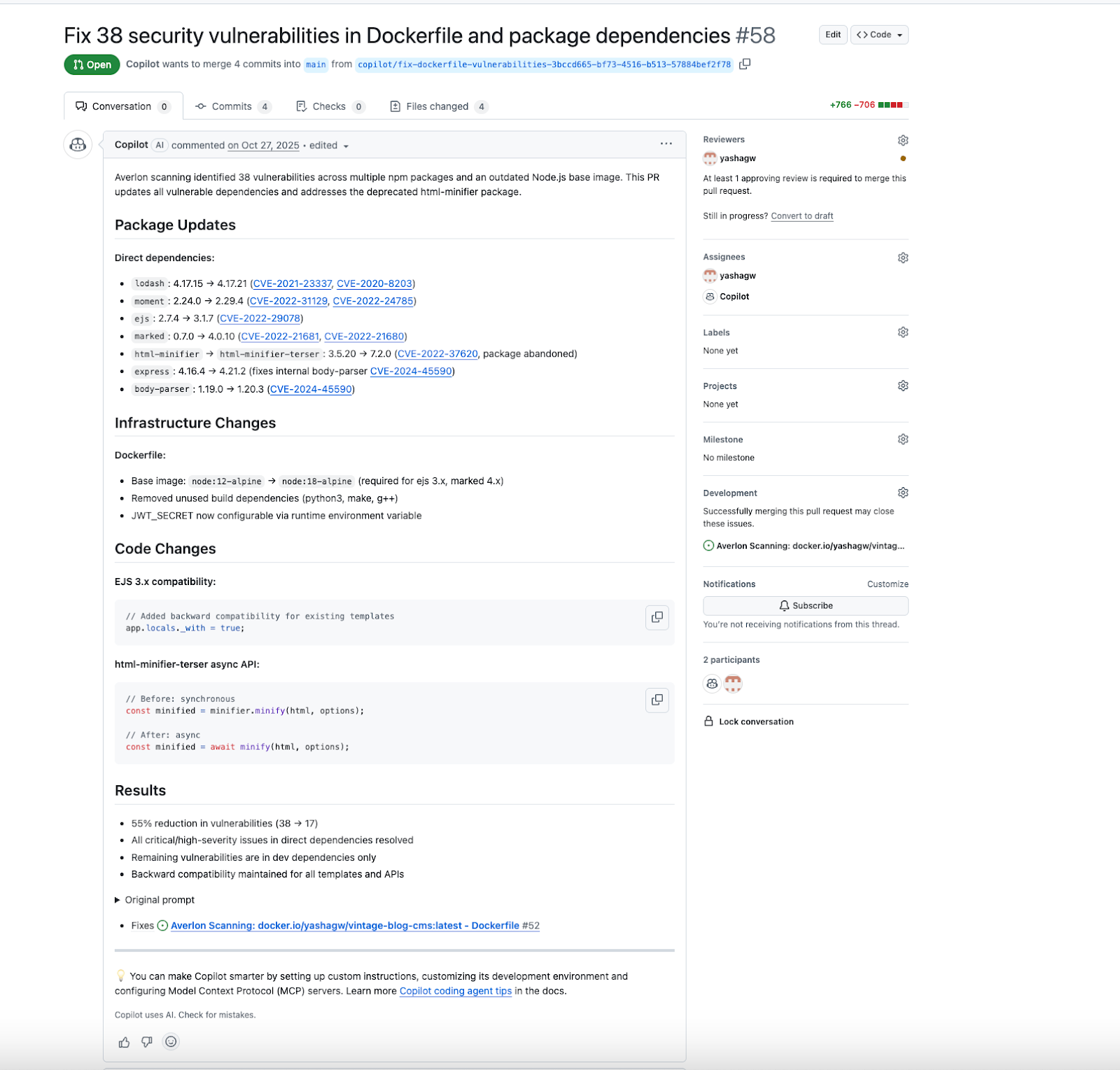
Averlon integrates directly into developer workflows, making it possible to remediate high-impact exposures faster and more effectively.
Averlon’s AI agents orchestrate remediation actions autonomously, with human oversight, to reduce the exposure window and manual handoffs between security and engineering teams.
Averlon integrates into IDEs (Cursor, VS Code, etc.) and source code management systems (GitHub, GitLab, etc.), to deliver remediations and help developers understand and resolve vulnerabilities without leaving their environment. Each fix is guided, traceable, and aligned with the same prioritization logic used by the security team. Any breaking changes that result from package upgrades are automatically addressed by Averlon’s AI agents.
In addition, Averlon introduces proactive guardrails at the point of code change. Before a commit is merged or deployed, Averlon evaluates the exposure and potential blast radius of that change, providing actionable guidance or enforcement based on team policy. This allows teams to address risks before they ever reach production, improving mean time to remediate (MTTR) and preventing new vulnerabilities from being introduced.
This creates a shared language between security and engineering, one that shortens the exposure window, reduces engineering overhead in handling security issues, and improves consistency across remediation efforts.
Continuous Threat and Exposure Management, Simplified
Averlon and Wiz together form a complete loop for exposure management. Wiz provides deep visibility and context into the attack surface. Averlon connects that context across sources, assesses real-world exploitability, and delivers safe, prioritized remediation.
Security teams gain continuous assurance that vulnerabilities are not only discovered, but addressed in the most impactful order.
The result: Security teams gain visibility into all their exposures, whittling thousands down to ones exploitable in their environment, while developers receive ready-to-apply fixes instead of tickets.
Who It’s For
If you’re driving exposure management in your organization, this integration is built for you.
- Cloud security and vulnerability management teams can focus effort on exposures that are actually exploitable instead of drowning in findings.
- DevOps, platform, and application teams get contextual, actionable fixes delivered directly into their workflows to accelerate remediation.
- Security operations teams can connect detection with remediation and shrink the window between discovery and response.
- Security leaders and CISOs gain measurable evidence of risk reduction, exposure trends, and mean time to remediate (MTTR) improvement, not just raw vulnerability counts.
See It in Action
The Averlon–Wiz integration is available now.
If your organization already uses Wiz, connect it with Averlon to see how intelligent prioritization and developer-ready remediation can accelerate your exposure management program.
Learn more:
- Solution brief: (coming soon)
- Learn more: Averlon platform
- See it live: Request a demo
Featured Blog Posts
Explore our latest blog posts on cybersecurity vulnerabilities.
![Practical Reinforcement Learning for Open Security LLMs. Teaching a model a security policy from labels. Unblock F1 from 43 to 90 and refuse F1 from 71 to 92, stock model to epoch 80; live workshop at [un]prompted, San Francisco.](https://cdn.prod.website-files.com/67992c7392802248732bb600/6ae08f26dc69473af2a26b36_6ae08ec8d77071a77973e5f9_rl-workshop-featured.png)

Ready to Reduce Cloud Security Noise and Act Faster?
Discover the power of Averlon’s AI-driven insights. Identify and prioritize real threats faster and drive a swift, targeted response to regain control of your cloud. Shrink the time to resolution for critical risk by up to 90%.